Stable Labeling Automation on Variable-Speed Conveyor Lines — A Natural, Comprehensive English Version
Stable Labeling Automation
In the competitive world of modern manufacturing, production lines rarely run at a constant pace from start to finish. Changing speeds, varying product types, and frequent production runs make consistent automation a challenge, especially where precision matters. One of the most demanding operations on such dynamic lines is labeling. Getting labels to stick exactly where they are intended — regardless of belt speed changes — can make the difference between a quality product and a costly rejection.
This case study describes how a tailored labeling automation solution was designed and implemented for a client in the food and chemical packaging industries, where plastic bottles and containers travel along a conveyor line whose speed varies depending on production demands. The project goal was simple in concept yet complex in execution: automate labeling so that each label is positioned precisely and consistently, whether the conveyor is running slow, fast, or anywhere in between.
Understanding the Customer’s Challenge
The customer operates a high-output manufacturing line producing liquid products in plastic bottles and packaging. Their conveyor does not run at a fixed speed throughout the day. Instead, line speed fluctuates based on production schedules, order urgency, and shift changes. Historically, labeling was done semi-manually. As the conveyor speed changed, labeling quality suffered. When the belt ran faster, labels tended to misalign; when it slowed, labels were inconsistently positioned relative to the product surface. This inconsistency not only created visual quality issues but also undermined the uniformity required by modern packaging standards. Label drift, misalignment, and other placement errors became a significant pain point — slowing production, increasing waste, and impacting brand perception on the retail shelf.
In more detail, the client faced several specific shortcomings with the original labeling method:
- Label Drift and Inconsistent Positioning: As conveyor speed fluctuated, labels failed to stick precisely where intended, resulting in visibly shifted placements on products.
- Lack of Standardization: Output quality was tied closely to speed settings and operator intervention, meaning identical products often ended up with different labeling quality depending on conditions.
- Appearance Issues: In industries such as food and chemicals where labeling contributes directly to brand perception and regulatory compliance, uneven labels negatively impacted customer trust.
- Operational Inefficiencies: Frequent adjustments and rework due to inconsistent labeling slowed down the line and increased reliance on operator oversight.
Faced with these persistent challenges, the customer sought a solution that would:
- Maintain consistent label placement regardless of conveyor speed variations
- Work in full harmony with the existing production line without requiring a complete system overhaul
- Reduce dependency on manual operator corrections
- Deliver reliable performance at both high and low speeds
The TagMatik Solution — A Real-Time Synchronized Labeling System
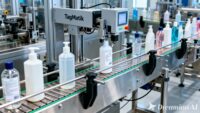
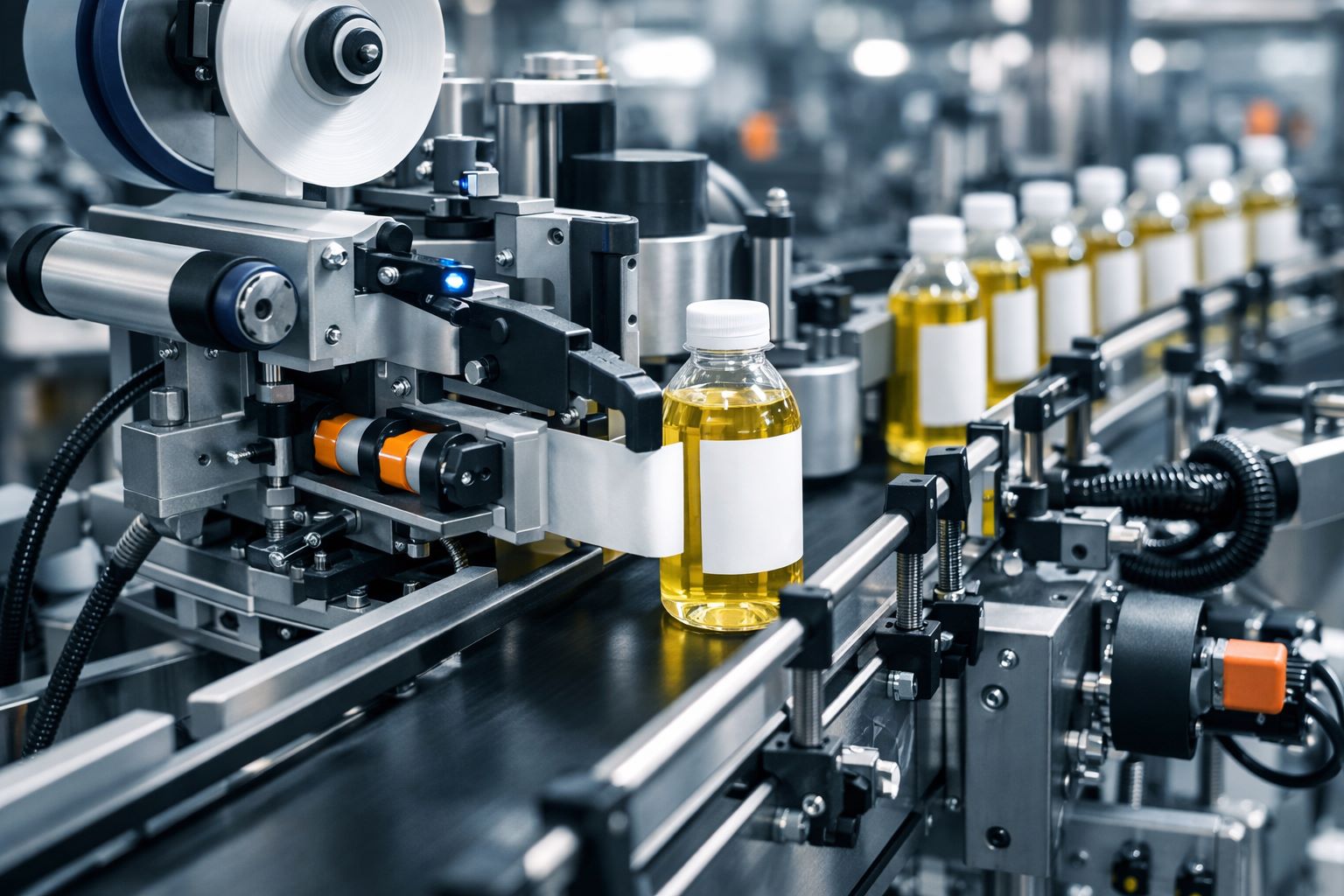
To meet the customer’s requirements, TagMatik engineers designed and deployed a high-precision, real-time synchronized labeling automation solution. The core innovation was a labeling applicator system capable of perceiving and responding instantly to changes in conveyor speed, ensuring that every label was applied at the exact intended location on each product.
Rather than applying labels at fixed intervals tied to an assumed constant speed (as many traditional systems do), this approach continuously monitors actual conveyor motion. It dynamically adjusts label application timing so that, even if the conveyor accelerates or decelerates, the label remains positioned exactly where the application point is intended on the product surface.
Here’s how the system achieves this:
- Real-Time Conveyor Speed Detection: Sensors and encoders installed on the conveyor detect instantaneous speed changes. Signals from these devices are fed continuously to the labeling system.
- Seamless Synchronization: The labeling head operates in lock-step with measured conveyor speed data, ensuring that label release timing aligns precisely with product position on the line.
- Product-Based Referencing: By anchoring label calculations to physical product reference points (such as leading edge sensors), the system maintains consistent placement across a wide range of operating conditions.
This technical approach results in a labeling process that does more than simply “stick a label on a bottle” — it integrates directly with the mechanical and control systems of the production line, making the labeling step a natural extension of the conveyor’s motion rather than an isolated operation.
Technical Implementation and Customization
Deploying such a responsive system requires both high-performance engineering and careful customization for the specific production context. Key components of the technical execution included:
- Dynamic Response Algorithms: The labeling software uses advanced algorithms that constantly recalibrate based on conveyor speed input, allowing the system to anticipate and respond to changes instantly rather than reacting after the fact.
- RS-485 Communication Interface: Conveyor speed information is transmitted to the labeling system via an RS-485 communication channel, ensuring fast, reliable data acquisition.
- Encoder Integration: Precision encoders installed on the conveyor track belt movement, providing high-resolution speed and positional data to the control system.
- Smooth Integration with Existing Infrastructure: A primary requirement was that the new labeling system integrate without disrupting existing production equipment, machine logic, or process flow. The installation was completed with minimal downtime, preserving line throughput during deployment and commissioning.
By positioning the automation solution to work as part of the natural line flow, rather than an add-on or retrofit with separate control logic, the system enhanced overall production stability rather than merely solving a single point problem.
Operator Experience and Usability
One of the chief benefits of this solution is the dramatic reduction in required operator interaction. Traditional semi-automatic labeling systems depend heavily on manual adjustments and repetitive fine-tuning to maintain quality under changing conditions. In contrast, the new automated system reduces such interventions to near zero, freeing operators to focus on oversight and exception handling rather than constant adjustment.
To support this, the system features a user-friendly Human-Machine Interface (HMI) that presents only essential information and hides noncritical configuration options from routine view. Operators can monitor performance and make simple adjustments without wrestling with complex parameter sets or frequent recalibrations.
Automated mode, meanwhile, handles the rest — adjusting labeling timing and placement dynamically without operator input.
Results and Achieved Benefits
After deployment, the impact of the new stable labeling automation was immediate and measurable:
- Consistent Label Placement: Even with wide swings in conveyor speed, labels maintained precise positioning relative to product reference points.
- Elimination of Speed-Related Errors: Misaligned and skewed labels, once common at variable speeds, were virtually eliminated.
- Improved Production Rhythm: The labeling process no longer contributed to line stoppages or quality-related slowdowns. Label application became a stable, predictable process step.
- Enhanced Product Presentation: Consistent label placement bolstered visual uniformity and professionalism on the finished products, supporting stronger brand perception at retail.
- Reduced Operator Burden: Manual corrections and real-time adjustments were minimized, reducing operator fatigue and potential for human error.
Furthermore, because the system adjusted dynamically to existing line conditions rather than imposing rigid speed constraints, the production flow remained fluid and uninterrupted. Consistency was no longer sacrificed for flexibility.
🔗 Please Feel Free to Contact Us:
WhatsApp: +90 531 888 61 09
✉️ E-Mail: info@tagmatik.com.tr
For Detailed Information About Our Products and Services:
TagMatik Aplikatör Grubu