Bottle Labeling Automation for Different Bottle Sizes in the Cosmetics and Cleaning Sector
This case study explores a bottle labeling automation project developed for a company operating in the cosmetics and cleaning products industry that manufactures plastic bottles in varying diameters and heights. Faced with a dynamic production environment where different bottle formats were processed on the same line, the customer struggled with the limitations of a semi-automatic labeling system and sought a more efficient, flexible solution.
Client Challenges and Initial Setup
Prior to automation, the client used a semi-automatic labeling method for plastic containers. While this approach worked for simple, small-scale production, the increasing product variety and rapid format changes began exposing critical weaknesses. Every time the line switched to a bottle with a different diameter or shape, the operator was required to manually adjust the labeling mechanism. These adjustments were often time-consuming and inconsistent, resulting in repeated line stoppages, extended setup periods, and labels that were uneven or improperly positioned on the bottle surface.
Although production continued, the manual adjustment process introduced inefficiencies and variability. The labeling results depended heavily on the operator’s experience; a less experienced operator might set label positioning slightly differently from one run to the next. Coupled with mismatches between conveyor speed and labeling timing, this caused variations in quality and sporadic rejects. With frequent format changes during multi-product shifts, these issues accumulated into significant productivity loss and visual inconsistency across products.
Customer Expectations and Requirements
Faced with these hurdles, the customer had a clear list of objectives for the new system:
- Flexible operation: A single labeling solution capable of handling multiple bottle formats without stopping the line or requiring mechanical realignment.
- Minimal manual intervention: A system that would reduce or eliminate operator dependency for format changeovers.
- Standardized precision: Accurately positioned labels with minimal variance across products, regardless of bottle size.
- High reliability at speed: Consistency even under high production speeds and varying line dynamics.
- Seamless integration: The ability to work with the existing conveyor, automation infrastructure, and production logic.
TagMatik’s Intelligent Labeling Solution
TagMatik’s response was more than simply selling a labeling machine; the team conducted a deep analysis of the customer’s production line, product variations, and automation environment to deliver a tailored solution that would fundamentally improve flexibility, consistency, and throughput.
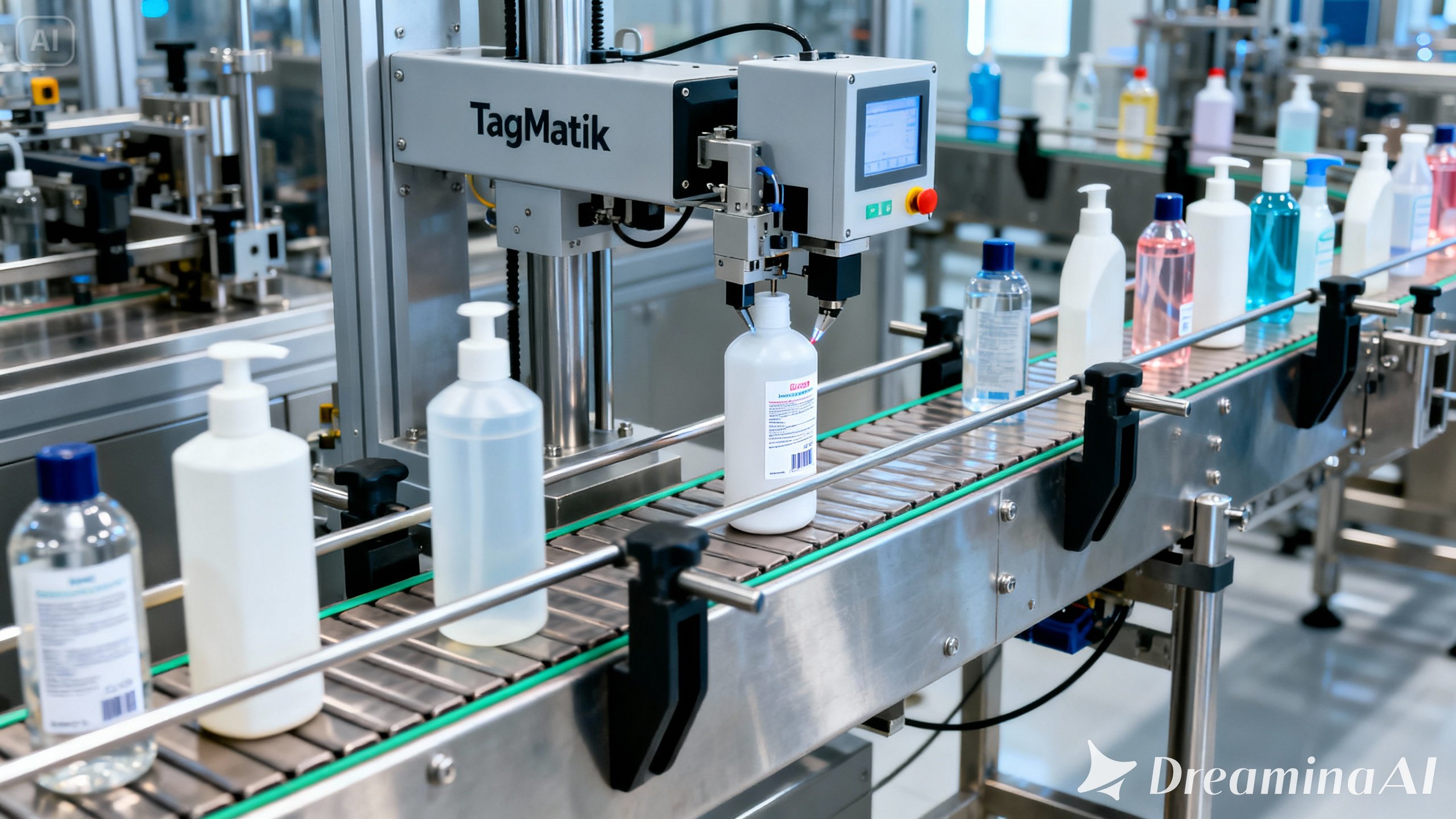
At the heart of the solution was an intelligent, software-driven labeling applicator system designed to eliminate the need for constant mechanical adjustment. Instead of manually adjusting hardware, the system automatically recognizes incoming products and dynamically calculates the correct label placement based on a pre-configured set of parameters.
Smart Product Detection and Recipe Management
Each product type was defined within a series of software recipes: structured sets of data defining the bottle’s diameter, label position, speed parameters, and alignment characteristics. When a bottle enters the line, low-profile sensors instantly identify which recipe to apply. This eliminates manual setup and means that product changeovers are completed in seconds instead of minutes.
The system also monitors the conveyor speed and adjusts label timing to maintain perfect alignment. This real-time integration ensures smooth transitions between bottles of varying speeds and formats without sacrificing quality or consistency — a challenge that traditional labeling solutions typically struggle with.
Easy Integration and Operator Experience
A key focus of the project was keeping the user experience simple and efficient. The new system integrated directly with the company’s existing PLC (Programmable Logic Controller) infrastructure, respecting the original conveyor layout and automation vocabulary. Because integration took place without interrupting the broader production ecosystem, there was no need for extensive line modifications.
The operator interface was purposefully straightforward. Instead of complex menus or multiple screen layers, the Human-Machine Interface (HMI) displayed only essential information. Operators could select or switch product recipes with a single touch and receive immediate feedback on system status. This reduced the cognitive load on staff while significantly enhancing operational control.
Outcomes and Business Benefits
Once deployed, the TagMatik labeling automation system delivered a wide range of tangible improvements across production, quality, and ease of use.
Dramatically Reduced Setup Times
One of the first impacts was a sharp reduction in production line stoppages and format change delays. Instead of several minutes or longer spent realigning equipment, changeovers now occurred in just seconds — simply by selecting the appropriate product recipe. This contributed to higher uptime and smoother line flow.
Consistent Quality Independent of Operators
Because label placement and timing were controlled algorithmically rather than manually, quality no longer varied between operators or shifts. Every bottle received labels that stayed consistent in alignment and precision — without over-reliance on individual skill.
Industry data confirms that automated labeling greatly improves consistency compared to manual processes, which are prone to mistakes and aesthetic imperfections due to human fatigue and error.
Improved Production Stability and Scalability
The system’s ability to add new products or update existing recipes without physical modification — just by entering parameter changes — gave the business future-proof flexibility. This makes it far easier to scale operations, introduce new SKUs, or pivot production lines without substantial downtime or retraining.
Operational Simplicity and Reduced Training Burden
By presenting only essential controls and eliminating unnecessary complexity in the user interface, operators could quickly learn and confidently operate the system. This reduced training time and dependence on specialized personnel.
Why Automation Matters for Labeling Lines
Automated labeling systems are now widely recognized as essential for any operation seeking efficiency, accuracy, and scale. Compared to traditional manual labeling — which is slow, prone to errors, and labor-intensive — automated systems deliver reliable outcomes at throughput levels that manual methods simply cannot match.
They also provide a stable platform for compliance, traceability, and branding consistency, which are critical in industries like cosmetics, pharmaceuticals, and consumer goods where presentation and information accuracy are paramount.
Conclusion
By deploying a TagMatik-engineered intelligent bottle labeling automation solution, the client was able to transform a previously bottleneck-prone, semi-manual process into a highly efficient, consistent, and operator-friendly system. The outcome was not merely a machine, but an adaptable, future-ready automation platform that boosted production speed, reduced manual effort, improved product quality, and enhanced operational reliability — setting the company up to meet both current demands and future growth with confidence.
🔗 Please Feel Free to Contact Us:
WhatsApp: +90 531 888 61 09
✉️ E-Mail: info@tagmatik.com.tr
For Detailed Information About Our Products and Services:
TagMatik Aplikatör Grubu