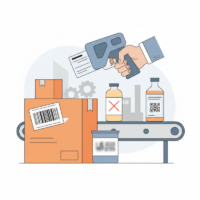



How Labeling Errors Affect Brand Perception
Labeling Errors Affect
When a product first meets a consumer on the shelf, that moment forms the earliest impression of the brand. Beyond simply conveying information, the label on a package stands as a reflection of the product’s quality, its reliability, and how professional the brand appears in the eyes of potential buyers. Because of this, errors in labeling often carry consequences that reach much further than most people realize.
Labeling on a production line is often one of the final steps before the product leaves the factory. When this process is done manually or semi-automatically, even small misalignments can occur. A crooked label, a shifted logo, or an imbalanced placement on a package may appear trivial at a glance, but in the mind of a consumer these imperfections can register as signs of carelessness. Over time, repeated exposure to these flaws can dampen trust in the brand itself.
Why Labeling Mistakes Happen
Understanding why labeling errors occur is key to addressing them. There are several common factors that contribute to mistakes during the labeling stage of production:
1. The Limitations of Manual Processes
When labels are applied by hand, the final look often depends heavily on the attention and precision of the individual worker. Even if the same product is being produced repeatedly on the same line, slight variations in label placement can appear from one operator to the next. This inconsistency becomes particularly visible in products where precision and aesthetic balance are critical — for example, in cosmetic packaging or personal care products.
2. Mismatches Between Conveyor Speed and Labeling Mechanisms
If the speed of the conveyor belt is not perfectly synchronized with the labeling equipment, labels may not be applied at the right moment. This disconnect can lead to labels being placed too high, too low, off to one side, or even partially missing the target surface entirely. In operations that require precise top, side, or full-wrap labeling, these timing issues can create noticeable visual discrepancies.
3. Variations in Product Shape and Surface Characteristics
Products with flat, uniform surfaces are relatively straightforward to label. However, when packaging surfaces are round, oval, or tapered, the margin for error increases significantly. In cases such as labeling bottles with curved contours, or containers with uneven surfaces, any instability in the labeling unit can result in visual distortions. If the labeling system doesn’t adequately compensate for the shape of the item, imperfections become unavoidable.
Real-World Scenarios Where Labeling Issues Often Appear
In many production facilities, labeling inconsistencies are not random, isolated incidents. Instead, they follow patterns tied to predictable conditions:
- During shift changes, variations in operator technique or calibration can lead to noticeable changes in label alignment.
- When different batches of the same product are processed, slight differences in label application may arise due to minor setup changes between runs.
- As production speed increases to meet demand, the rate of labeling errors often increases if equipment and operators are not equipped to maintain consistent precision at higher volumes.
- Products requiring labels on multiple sides may show imbalance if the system is not calibrated to handle double labeling with care.
- Frequent manual interventions to adjust labeling dispensers can introduce irregularities in label placement.
These scenarios demonstrate that labeling errors are not random; they often reflect systemic challenges in the production workflow.
How Labeling Errors Impact Brand Perception
The consequences of labeling mistakes extend far beyond the production line. On the consumer side, their impact can be surprisingly deep and wide-reaching:
Loss of Trust
Consumers often interpret visual imperfections as signals of a brand’s overall quality standards. In industries where compliance and accuracy are critically important — such as food and beverage labeling or chemical products — a misaligned or flawed label can trigger doubt about safety, reliability, and care. When consumers encounter packaging that appears sloppy or careless, they may hesitate to trust the product itself.
Reduced Perceived Quality
Even subtle errors can shift how a consumer perceives a brand’s value. In categories like cosmetics, where visual presentation is a major part of purchase decision, an asymmetric or irregular label can make a product appear inferior compared to its competitors. In such cases, quality perception suffers even if the product inside the package is high quality.
Influence on Purchase Decisions
When a consumer scans the shelf, their eye is drawn to products that project confidence and consistency. Products with uneven, unpredictable, or visually unbalanced labels can become easy to overlook. Shoppers tend to gravitate toward items that present a consistent and polished look, and inconsistent labeling can subtly discourage purchase decisions.
This effect tends to be more noticeable with certain types of packaging — for example, plastic bottle labeling or glass bottle labeling — where the visual look on the shelf is a significant factor in consumer choice.
Approaches to Reducing the Impact of Labeling Errors
To minimize the negative effects labeling problems have on brand perception, production operations can adopt several general strategies:
Invest in Automated Labeling
Automated labeling systems reduce reliance on human judgment and repetition. By introducing solutions that integrate directly with production lines, the process becomes less dependent upon operator skill and attention. This shift toward automation brings several advantages:
- Every product receives a label in the exact same position every time.
- High-precision bottle labeling systems guarantee visual consistency across batches.
- High-speed food labeling solutions ensure that production volume and consistency are not mutually exclusive.
- For complex labeling needs, such as dual-sided products or full-wrap applications, controlled automation maintains symmetry and balance.
Automated uniform labeling reduces the visual noise that manual processes can create, making products look more cohesive as part of a brand’s portfolio.
Benefits of Moving to Automated Labeling
Production facilities that transition from manual application to fully automated labeling systems report several key gains:
- Uniform label placement on every single unit produced.
- Greater visual consistency, particularly with complex packaging shapes.
- Maintenance of production speed without sacrificing precision.
- Enhanced control over processes that were previously dictated by human dexterity alone.
- Better ability to measure and manage labeling outcomes through measurable data and integrated system controls.
Systems such as label dispensers, integrated line labeling modules, and advanced application units play a critical role in delivering these results.
A Real-Life Observation from the Field
In facilities where automated solutions have replaced manual labeling, complaints related to brand perception and packaging quality drop noticeably. This is especially true in industries such as household cleaning products, chemical packaging, and personal care items like shampoos and liquid soaps. Visual uniformity improves significantly when automated systems ensure every product looks consistent, clean, and well-aligned.
This evidence shows that labeling errors are not simply a technical issue on the line — they represent a perceptual challenge that affects how a brand is seen in the marketplace.
In Closing
Small errors in the labeling process can have disproportionately large effects on how a brand is perceived by consumers. Because these mistakes influence trust, quality perception, and ultimately purchase decisions, they demand a thoughtful, comprehensive response. True resolution involves more than tweaking a setting here or providing additional operator training there. It requires a holistic approach that elevates the labeling process itself into a controlled, predictable, and measurable part of production.
In industrial labeling applications, a well-engineered labeling system that prioritizes consistency and precision stands as one of the most significant factors influencing how a brand presents itself on the shelf — and how it is remembered by customers.
🔗 Please Feel Free to Contact Us:
WhatsApp: +90 531 888 61 09
✉️ E-Mail: info@tagmatik.com.tr
For Detailed Information About Our Products and Services:
TagMatik Label Applicator